- Shopping, made easy.
- /
- Get the app!
Dual run capacitors are commonly used in HVAC (heating, ventilation, and air conditioning) units. Dual capacitors have three terminals, unlike regular run capacitors, which have only two. Electrically, they are the same as run capacitors that have two terminals. Using a dual run capacitor allows you to save space if you have a small mounting area. The terminals are also clearly marked, making it easy to hook it up to the different components of your air conditioner.
Dual capacitors usually have connections marked "C" for "common," "H" or "HERM" for the hermetic compressor, and "F" or "FAN" for the fan in an HVAC unit. They also have two different capacitance ratings (for example, 40/5 uf). The larger value is always connected to the compressor (40 uf in the example), while the smaller value will always be connected to the fan (in this case, 5 uf).
SPECIFICATIONS:
Model: CBB65 (Universal model)
Case Material: unpainted aluminum case.
Dielectric Material: metallized polypropylene film.(NON-PCB)
Available Capacitance: 40+5 uF
Capacitance Tolerance: ±5%.
Operating temperature: -40℃ to +70℃/-104℉ to +158℉.
Frequency: 50/60 Hz.
Safety rated: 10,000 AFC - Available Fault Current.
Operating Life: 60,000 hours with 94% survival (In accordance with the EIA456 Industry Standard).
Dissipation Factor: 0.1% maximum.
When an AC capacitor replacement is necessary, you'll experience any number of common symptoms, including:
1)The voltmeter says there are too few microfarads.
2)It's swollen like a balloon. .
3)The capacitor leaks oil.
4)Your air conditioner doesn't turn on at all, Or it's running but doesn't dispense cool air and so on.
Sometimes, an old, rusty-looking capacitor will still read at the appropriate level of microfarads. It really comes down to the voltmeter reading, physical swelling, and/or the presence of oil.
 DINSTUDIO 10Pcs 10A Slow Blow Fuse 10 Amp Time Delay Fuse T10AL250V Slow Acting T10AL 250V Glass Fuse 5x20mm
KWD 3.500
DINSTUDIO 10Pcs 10A Slow Blow Fuse 10 Amp Time Delay Fuse T10AL250V Slow Acting T10AL 250V Glass Fuse 5x20mm
KWD 3.500
 20Pcs 10A Ceramic Slow Blow Fuse 10 Amp Time Delay Fuse 250V Glass Fuse T10AH250V 5x20mm
KWD 3
20Pcs 10A Ceramic Slow Blow Fuse 10 Amp Time Delay Fuse 250V Glass Fuse T10AH250V 5x20mm
KWD 3
 DINSTUDIO 10Pcs 4A Slow Blow Fuse 4 Amp Time Delay Fuse T4AL250V 250V Slow Acting Glass Fuse 5x20mm
KWD 3.500
DINSTUDIO 10Pcs 4A Slow Blow Fuse 4 Amp Time Delay Fuse T4AL250V 250V Slow Acting Glass Fuse 5x20mm
KWD 3.500
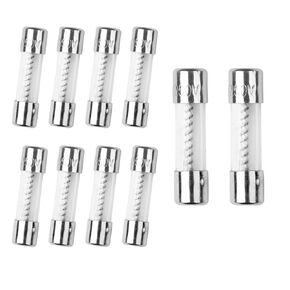 10Pcs 0.75A Slow Blow Fuse 0.75 Amp 750mA Time Delay Fuse T0.75AL250V 250V Slow Burn T0.75AL Glass Fuse 5x20mm
KWD 3.500
10Pcs 0.75A Slow Blow Fuse 0.75 Amp 750mA Time Delay Fuse T0.75AL250V 250V Slow Burn T0.75AL Glass Fuse 5x20mm
KWD 3.500