- التسوق ، اصبح سهلا.
- /
- احصل على التطبيق!
MeterTo
MeterTo mainly offers instruments and tools.
Please confirm the product is offered by our store MeterTo when purchasing,
otherwise we can't ensure the quality and after-sale service.
HR-Rockwell Hardness
Rockwell hardness (HR-) value is determined by the indentation plastic deformation depth.
With 0.002mm as a hardness unit, when HB>450 or sample is too small, Brinell hardness test cannot be used instead of Rockwell hardness measurement.
It uses a diamond cone with a vertex angle of 120° or a steel ball with a diameter of 1.59/3.18,
which is pressed into the surface of material to be tested under a certain load,
and the hardness is determined from the depth of the indentation.
HRA is a hardness obtained by using a 60kg load and a diamond cone indenter for materials with extremely high hardness (such as cemented carbide).
HRB is a hardness obtained by hardened steel ball with a load of 100kg and a diameter of 1.59mm. The hardness is used for materials with lower hardness (such as annealed steel, cast iron, etc.).
HRC is a hardness obtained with a 150kg load and a diamond cone indenter for materials with high hardness (such as hardened steel).
HRC means Rockwell hardness C;
HRC and HB are widely used in production;
The applicable range of HRC is HRC20-67, which is equivalent to HB225-650. If hardness is higher than this range, Rockwell hardness A HRA is used; if hardness is lower than this range, Rockwell hardness B HRB is used. The upper limit of Brinell hardness, HB650, cannot be higher than this value.
The Rocker hardness tester C head is a diamond cone with a top angle of 120°, and the test load is a certain value.
Rockwell hardness indentation is small, need to do average measurement, and applicable for finished product and sheet, belong to non-destructive testing.
The Rockwell hardness is an unnamed number with no units.
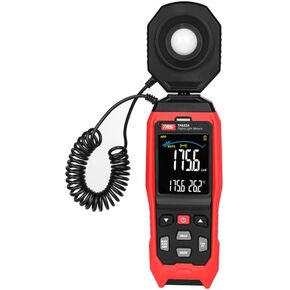 Lux Meter Iluminometer Luminometer Meter مع عرض الإضاءة الخلفية ، 1 ~ 200.000Lux
KWD 36.500
Lux Meter Iluminometer Luminometer Meter مع عرض الإضاءة الخلفية ، 1 ~ 200.000Lux
KWD 36.500
 1PCS كتلة صلابة الشاطئ المهنية 30 ± 4HSD كتلة اختبار الصلابة سطح العين
KWD 39
1PCS كتلة صلابة الشاطئ المهنية 30 ± 4HSD كتلة اختبار الصلابة سطح العين
KWD 39
 1pcs كتلة صلابة knoop احترافية 700-800 HK0.2 مربعة اختبار الصلابة سطح
KWD 43.500
1pcs كتلة صلابة knoop احترافية 700-800 HK0.2 مربعة اختبار الصلابة سطح
KWD 43.500
 الفك الطويل الفك ، 0-300 مم / 0-500 مم ، 0.0005 " / 0.01 مم دقة ، بوصة و MM ، قبل ، ABS (0-300 مم الفك 100 مم)
KWD 68
الفك الطويل الفك ، 0-300 مم / 0-500 مم ، 0.0005 " / 0.01 مم دقة ، بوصة و MM ، قبل ، ABS (0-300 مم الفك 100 مم)
KWD 68